Why open source project AURA is critical in the AI era

As featured in AI Journal by journalist Erika Balla.

The rapid rise of AI-driven development has unlocked enormous potential across industries driven by unlimited coding capacity and unlimited analytical capability introduced by coding agents and the latest generation of models. The need for a reliable, auditable, and interoperable system for organizing the contextual signals that drive safe, relevant, and accountable behavior has never been more important for managing production where changes are higher risk than re-running tests in development when the model hallucinates or makes a mistake.

That’s where AURA comes in.

AURA is an open source project started by Mezmo that provides an extensible system of context for AI applications. Agents built on AURA make better decisions, explain actions, and integrate safely into real-world workflows.

The problem: context overload and data bloat

Modern AI agents rely heavily on context e.g. user history, real-time signals, system telemetry, policy constraints, and more in order to accomplish their tasks. Today that context is frequently:

  • Fragmented across services and silos.
  • Ad-hoc and proprietary, limiting interoperability.
  • Opaque, making verification, auditing, and debugging difficult.
  • Transient or unavailable at inference time, leading to irrelevant or unsafe outputs.

These issues hinder reliability, slow development, increase integration costs, and amplify model risks (bias, hallucinations, or harmful actions) when agents are assigned to mission-critical tasks.
What AURA provides

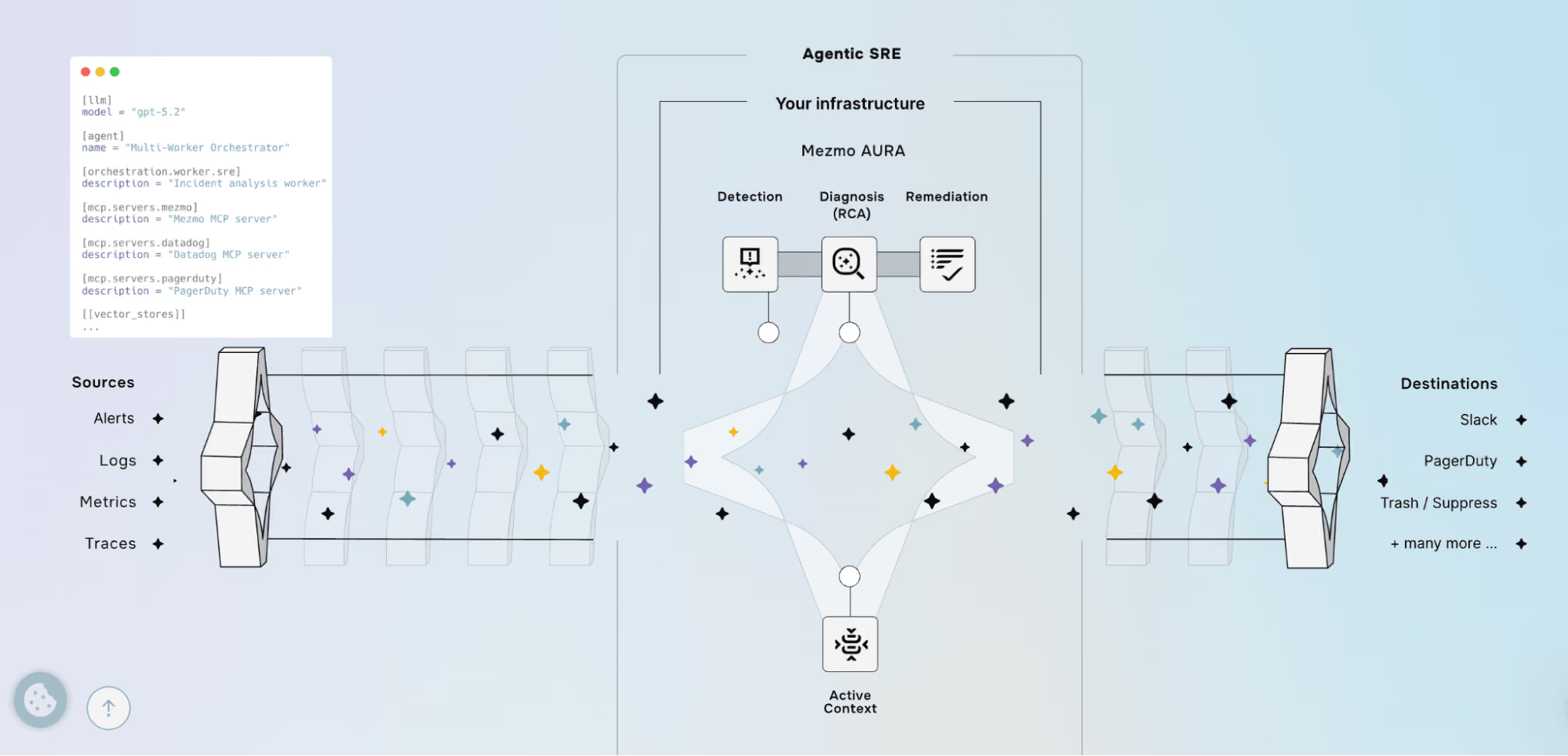
AURA is an open system for getting the right context to AI systems at the right time. It’s built around a few convictions:

  • Open by default. Community-governed formats and interfaces. No proprietary lock-in. If you swap out a component, your context still works.
  • Your domain, your schema. Extensible enough to carry business rules, data lineage, and operational metrics alongside the usual signals; not just what we thought you’d need.
  • Now and then. Streaming context for what’s happening right now. Archived records for what happened before. Agents need both to reason well.
  • Traceable end to end. Every piece of context carries provenance: where it came from, when it was used, what it influenced. You can audit the full chain from input to output.
  • Policy-aware from the start. Consent, redaction, retention, and enforcement aren’t bolted on. They’re built into the context lifecycle so teams can move fast without moving recklessly.

How this changes AI SRE as a category

Right now, every team building AI into their SRE workflow is solving the same problem badly. They cobble together context from six different tools, shove it into a prompt, and hope the model figures out what matters. When it doesn’t, they add more context. When that breaks the token window, they start hacking together their own retrieval layer. Everyone is building the same plumbing, and nobody’s plumbing is good.

AURA kills that cycle. It gives agents a single, structured way to access the context they actually need: user history, telemetry, policy rules, operational state. One set of interfaces, open formats, works with whatever tools you already run. Your RCA agent and your remediation agent and your observability dashboards all pull from the same place.

And because it’s open source, the context layer isn’t a black box. You can see exactly what the agent saw when it made a decision. You can audit it. You can hand that audit to your compliance team and they can actually read it. Try doing that with a proprietary agent that assembles its own context behind closed doors.

The other thing that matters: patterns travel. When one team figures out a good way to structure context for Kubernetes incidents, that pattern is reusable. Not locked inside one company’s product, not gated behind an enterprise contract. Just available. That’s how a category grows up instead of fragmenting into fifty incompatible silos.

Call to action

As AI systems become more capable and more embedded in decision-making, the importance of reliable, auditable context cannot be overstated. Organizations building or deploying AI should evaluate how they manage contextual signals today and consider adopting or contributing to open initiatives like AURA to improve safety, interoperability, and trust. Participation through testing, contributing code, defining schemas, and/or adopting standards accelerates progress for everyone.

AURA is addressing a foundational infrastructure gap for the AI era: a standardized, open, and auditable system of context. By enabling models to access rich, governed, and traceable signals, AURA helps make AI systems more useful, safer, and easier to integrate at scale. Supporting and adopting open context systems is a practical step toward more responsible and effective AI-driven developmen

Next news
You're viewing our latest news item.
Previous news
You're viewing our oldest news item.
Why open source project AURA is critical in the AI era
Why AI Agents Fail Quietly in Production
NightVision Interview Series with Mezmo CEO, Tucker Callaway
Making Data Agent Ready - an interview with Software Huddle
Introducing AURA: Building an Open Agentic harness for production AI
Why We Need an Open Source System of Context in the AI Era
Agentic AI Foundation Welcomes 97 New Members As Demand for Open, Collaborative Agent Standardization Increases
10 Software Companies to Watch in 2026
How Mezmo Cuts AI Observability Costs by 90% With Context Engineering | Tucker Callaway
Code Story: Insights from Startup Tech Leaders with Mezmo's Tucker Callaway
2026 Observability Predictions - Part 3
2026 Observability Predictions - Part 1
How AI-Driven Observability Is Transforming SRE: Insights from Mezmo CEO Tucker Callaway
2026: The End of the Dashboard as We Know It?
The Importance of Context Engineering in the AI Era
Mezmo: Named One of The Top 50 Software Companies of 2025
Why Synthetic Tracing Delivers Better Data, Not Just More Data
Why Agentic SREs Require Active Telemetry in Kubernetes
5 Startups Defining AI SRE
Mezmo Launches AI SRE Agent for Root Cause Analysis
AI-Driven Observability with Tucker Callaway | The Software With Podcast
Mezmo CEO Tucker Callaway on Active Telemetry, Context Engineering, and the Fastest AI SRE for Kubernetes | 10KMedia Podcast
Mezmo Launches Fast & Precise AI SRE for Kubernetes Ahead of KubeCon
Mezmo Wins 2025 Digital Innovator Award from Intellyx
Mezmo Announces Cost Optimization Workflow to Reduce Observability Spend for Datadog Users
Mezmo Disrupts Market by Reducing Observability Cost Structure by 90%
Building trust in telemetry data [Q&A]
2025 Observability Predictions - Part 1
Mezmo Simplifies Management of Telemetry Data to Reduce Observability Costs
At KubeCon/CloudNativeCon 2024, AI hype gives way to real application concerns
Mezmo Unveils Mezmo Flow for Guided Data Onboarding and One-Click Log Volume Optimization
Mezmo Flow Released
What’s new from KubeCon + Cloud Native Con North America 2024
Mezmo Unveils Mezmo Flow for Guided Data Onboarding and One-Click Log Volume Optimization - Yahoo Finance
Real-time Analytics News for the Week Ending November 16
Analytics and Data Science News for the Week of November 15; Updates from Alteryx, DataRobot, ThoughtSpot & More
Modern Observability Through Application Development
Mezmo Unveils Mezmo Flow for Guided Data Onboarding and One-Click Log Volume Optimization
Mezmo CEO Tucker Callaway Shares Observability Insights and KubeCon + CloudNativeCon 2024 Plans
Telemetry Data: The Puzzle Pieces of Observability
Q&A with Tucker Callaway, CEO of Mezmo
Mezmo Makes Inc. 5000’s List of Fastest Growing Companies in the Nation for Third Consecutive Year
7 Ways Telemetry Pipelines Unlock Data Confidence
The 2024 SD Times 100: 'Best in Show' in Software Development
Mezmo Hires Former StackHawk, New Relic Leader as Vice President of Product
Inside the VP of Sales' Journey: Financial Software to AI Startups - Craig McAndrews Spills it all!
Mezmo: Adding In-Stream Alert Capabilities to Telemetry Pipeline Platform
An IT Manager's (Re)View of the RSA Conference
Real-time Analytics News for the Week Ending May 11
Mezmo Adds Industry-First Stateful Processing in Telemetry Pipelines
SalesTechStar Interview with Craig McAndrews, Vice President of Sales at Mezmo
Mezmo Ranks No. 82 on Inc. Magazine’s List of the Pacific Region’s Fastest-Growing Private Companies
How To Break Down Silos To Get More Benefit From Your Data
Mezmo Bolsters Sales Leadership With New Hires From Chef and Apptio
How Metric Normalization Enhances Data Observability
KubeCon 2023: Telemetry and Data Management
Telemetry Data’s Role in Cybersecurity – Tucker Callaway – Enterprise Security Weekly
Breaking data silos between observability and security empowers organizations
2024 Application Performance Management Predictions - Part 3: Observability
Data Management News for the Week of November 10; Updates from AWS, Monte Carlo, Satori & More
Real-time Analytics News for the Week Ending November 11
At KubeCon NA 2023, finding cloud independence on the edges of Kubernetes
Mezmo Introduces Data Profiling and Responsive Telemetry Pipelines for Kubernetes
Data Profiling & Responsive Telemetry Pipelines For Kubernetes | Mezmo
KubeCon: GKE Enterprise gets release date, Mezmo adds data profiling feature, and more
Data Profiling & Responsive Telemetry Pipelines For Kubernetes | Mezmo
Optimize Your Observability Spending in 5 Steps
Take Control of Your Kubernetes Telemetry Data
The Role of Observability Engineers in Managing Complex IT Systems
Mezmo Launches Welcome Pipeline to Unlock Kubernetes Insights Faster
Mezmo Ranks #1,386 on Inc. 5000’s List of Fastest Growing Companies in the Nation
Mezmo Simplifies Management of DevOps Telemetry Data
Mezmo Empowers Enterprises to Extract Business Insights from Telemetry Data
How DevOps Teams Can Manage Telemetry Data Complexity
Mezmo Wins the 2023 Digital Innovator Award from Intellyx
Tucker Callaway, Mezmo | RSA Conference 2023
Mezmo: Cloud Native Telemetry Pipeline
Mezmo Adds Free Community Plan for Managing Observability Data
Mezmo Announces Free Access to Telemetry Pipeline
Tame Telemetry Data With Mezmo Observability Pipeline
Mezmo Named 2023 Log Analytics Solution of the Year In Data Breakthrough Awards
Down the Observability Pipeline with Mezmo
How Developers, SRE Teams, and Security Engineers Use Telemetry Data
Data Pipeline Feeds IT's Observability Beast
How to Maximize Telemetry Data Value With Observability Pipelines
Mezmo Ranks #53 on Inc. Magazine’s List of Fastest-Growing Companies in the Pacific Region
Mezmo 2023 Predictions: More Organizations Adopt OpenTelemetry
Understanding Observability Data's Impact Across an Organization
Solutions Review Names 6 Data Observability Vendors to Watch, 2023
DevSecOps Accelerates Incident Detection, Response Efforts
2023 Application Performance Management Predictions - Part 3
Mezmo-Harris Poll Report Explores the Impact of Observability Data
Mezmo Wins Intellyx 2022 Digital Innovator Award
Mezmo Ranked No. 164 on Deloitte Technology Fast 500
Mezmo Wins 2022 Reworked IMPACT Award
Mezmo Unveils Observability Pipeline to Enhance the Value of Data
Launching a podcast? Try these 14 tips for greater exposure
DevSecOps Expedites Incident Detection and Response Time
Mezmo Named A Fastest Growing Company On Inc. 5000